How to Design Patient-Centred Medical Market Research
There is a growing recognition that patient experience is key to every aspect of medical decision-making. Whereas, in the past, a disease-centred approach focused first and foremost on science and the development of medicine to treat disease or alleviate symptoms. Now patient-centred research offers the unique perspective afforded by users of those medicines.
At LDA Research we receive requests several times a week for patient-centred research. Our clients recognise the importance of gaining insights from patients who have a personal perspective on their disease and the range of therapies available to treat it.
Designing Patient-Centred Research Studies
Successful patient-centred market research begins with recognition of the needs and requirements of patients who will form the focus of the study. Whilst it’s clear that patients with macular degeneration, for example, won’t be able to manage an online interview, there are many medical conditions where secondary symptoms also need to be taken into consideration.
For over a decade now, the LDA Research team has been designing patient-centred medical market research for clients in the UK, US and across the globe. In the interests of further developing the patient perspective, we thought it would be useful to share our experiences of designing research involving patients with specific diseases.
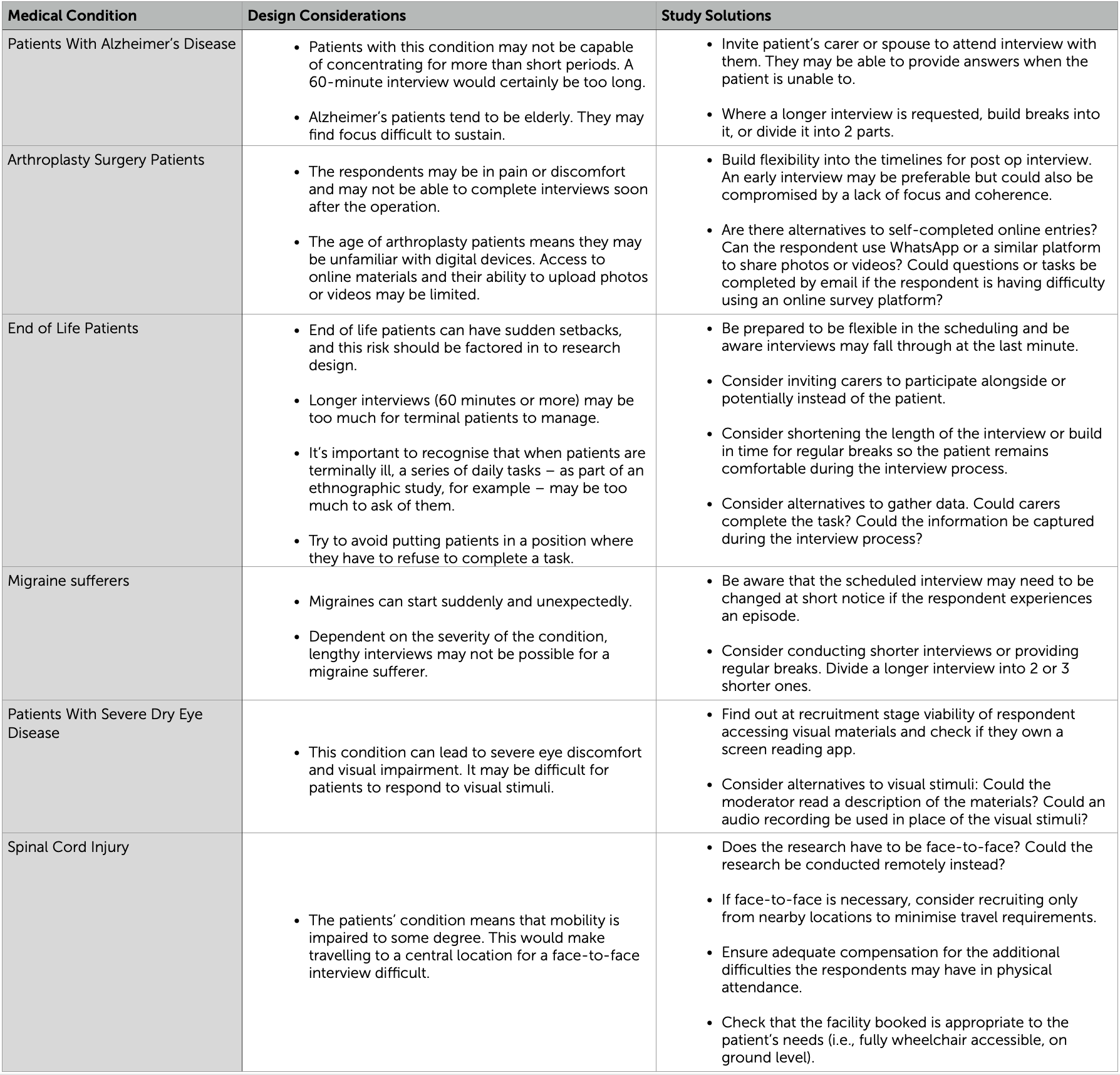
Summary of Patient-Centred Research Design Considerations
There are two questions requiring consideration when we design medical market research around patients. We always begin by asking ourselves whether the patient’s condition, and/or their age, could impact on the tasks we are asking them to participate in. If the answer is ‘yes’, we find ways to factor in solutions at an early stage of planning.
There are a number of adjustments that can be made to improve the patient experience of research participation:
- Always try to arrange for virtual participation which allows patients to participate from the comfort of their own home.
- Keep interviews short or build in breaks.
- Be ready to be flexible around last-minute scheduling changes due to patient needs.
- Consider whether the data you are looking for could be gathered through caregivers/carers rather than the patients.
- Consider the methodology used to gather pre- or post- interview data and adapt it according to the patient profile.
Working With LDA Research
The LDA Research team has over a decade’s experience in recruiting patients for healthcare studies, including out-of-the-ordinary patients. We employ a mix-and-match approach to our wide-ranging methodologies, which include online interviews, video diaries, ethnographic studies, surveys, and questionnaires.
We have dedicated healthcare panels in the UK and US and have developed an extensive network of partners with international panels. Currently our field partners span Europe, the US, Canada, South America, South Korea, China, Mexico, Japan, the Middle East, and the South Pacific.
Would you like to talk to a member of the LDA Research team about working with us? Call us today on 01525 861436